Tailscale should work. It uses Wireguard and does some UDP fuckery to get around the firewall and NAT (including CGNAT). I can stream Jellyfin through it at 1080p native with no significant buffering, it’ll work for music.
I take my shitposts very seriously.
- 19 Posts
- 1.3K Comments
rtxn@lemmy.worldto
Linux Gaming@lemmy.world•How do I run two programs in the same Lutris instance?English
19·3 days ago“Run EXE inside Wine prefix”

It might not work, though. I’ve tried to use a similar tool with Snowrunner, it found the process, but didn’t actually work.
rtxn@lemmy.worldto
Linux Gaming@lemmy.world•No Man's Sky Multiplayer works on Steam Deck, but not Arch LinuxEnglish
3·4 days agoOne of these might help: https://steamcommunity.com/app/275850/discussions/0/601902145259725017/
Although I wouldn’t be surprised if it was caused by NMS’s own network backend. When the Corvette update was launched, multiplayer was fine on my work computer, but did not work on my home PC. It’s a constant dumpster fire.
rtxn@lemmy.worldto
Linux Gaming@lemmy.world•Lutris doesn't proton variations such as Proton-EM?English
3·6 days agoIf you have Steam installed, try putting them in
~/.local/share/Steam/compatilitytools.d.
3-day timeout. Stop being a dick.
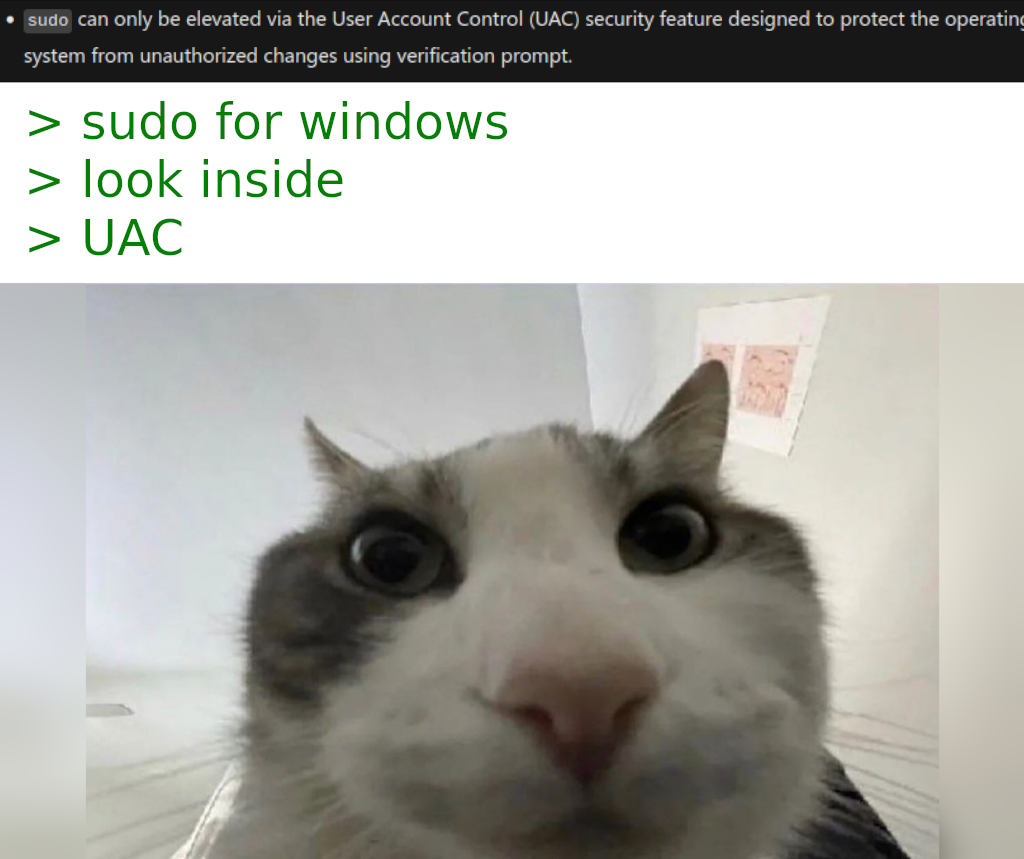
Uh… kinda? Powershell has many POSIX aliases to cmdlets (equivalent to shell built-ins) of allegedly the same functionality.
rmdirandrmare both aliases ofRemove-Item,lsisGet-ChildItem,cdisSet-Location,catisGet-Content, and so on.Of particular note is
curl. Windows supplies the real CURL executable (System32/curl.exe), but in a Powershell 5 session, which is still the default on Windows 11 25H2, thecurlalias shadows it.curlis an alias of theInvoke-WebRequestcmdlet, which is functionally a headless front-end for Internet Explorer unless the-UseBasicParsingswitch is specified. But since IE is dead, if-UseBasicParsingis not specified, the cmdlet will always throw an error. Fucking genius, Microsoft.
rtxn@lemmy.worldto
Linux Gaming@lemmy.world•Linus vs Linus Happened: Building the PERFECT Linux PC with Linus Torvalds [54:20]English
10·9 days agoHe can’t, he had to re-run a benchmark.
Never let perfection be the enemy of getting it to work.
rtxn@lemmy.worldto
Selfhosted@lemmy.world•How to propperly Ansible and selfhost without burning out?English
9·10 days agoIs this what normies feel like when Linux users tell them to just use Linux? I have some apologies to make.
rtxn@lemmy.worldto
Games@lemmy.world•A cool feature/mechanic you want to see in games againEnglish
6·11 days agoMy opinion is the exact opposite. Narrative games, even action shooters, need to have high action and low action parts in balance. If high action segments are excessive, it can lead to combat fatigue. If low action parts are excessive, the player gets bored and the pacing dies.
Half-Life 2 E1, the “Low Lives” chapter, has probably the most stressful combat in the game because the player has to balance so many things. Shooting the zombies attacking Gordon versus helping Alyx fight. Helping Alyx versus keeping the flashlight charged. Firearms versus explosive props. All of that in oppressive darkness. Combat fatigue sets in. The short puzzle segments, even as simple as crawling through a vent to flip a switch, are opportunities to take a breath, absorb the environment, and prepare for the next segment – especially at the end of that particular chapter, when the player escapes the zombies and has a chance to wind down.
At the same time, puzzles, by their slower nature, are excellent for delivering narrative and player training, and to let the player absorb the atmosphere. Alyx’s first encounter with the stalkers in “Undue Alarm” wouldn’t have had the same emotional impact if the player could just pop them in the head and move on.
In contrast, most of “Highway 17” is just a prolonged vehicle-based puzzle. By the time the player reaches the large railway bridge, they might be sick of driving. I know I was. It’s a relief to finally engage in some platforming and long-range combat while traversing the bridge.
So what are the narrative values of my two examples? The cinderblock seesaw in “Route Kanal” is just player training. A show, don’t tell method to let the player know that physics puzzles will be a factor. It’s also a short break after the on-foot chase, before the encounter with the hunter chopper. In “Water Hazard”, the contraptions serve a larger narrative purpose: they’re the tools of the rebels’ refugee evacuation effort. The player utilizes them like one of the refugees would have.
rtxn@lemmy.worldto
Games@lemmy.world•Valve dev counters calls to scrap Steam AI disclosures, says it's a "technology relying on cultural laundering, IP infringement, and slopification"English
9·11 days agoauto complete
It’s called lexical analysis or lexical tokenization. It existed long before LLMs (as long as high-level programming languages have, since lexical analysis of the source is the first step of compilation), it doesn’t rely on stolen code, and doesn’t consume a small village’s worth of electricity. Superficial parallels with chatbots do not make it AI – it’s a fucking algorithm.
Besides, there is a world of difference between asking a clanker to spit out a Python function that multiplies two matrices, and putting the knock-off Shadowheart from TEMU in a million-dollar game.
rtxn@lemmy.worldto
Games@lemmy.world•Valve dev counters calls to scrap Steam AI disclosures, says it's a "technology relying on cultural laundering, IP infringement, and slopification"English
9·11 days agoThen you should hold yourself to higher standards than “people”.
rtxn@lemmy.worldto
Games@lemmy.world•Valve dev counters calls to scrap Steam AI disclosures, says it's a "technology relying on cultural laundering, IP infringement, and slopification"English
27·11 days agoMaybe some people, who are an ocean away from me, have been gaslit into thinking they can’t be anything other than consumers. I know it can be difficult to grasp the concept, but you can refuse a service if the terms are unacceptable. It is possible to go into a transaction with open eyes and full knowledge of the rights granted to you by law and responsibilities demanded of you by the contract.
That’s why I say “customer”. It’s a reminder to myself that I should demand equitable treatment, even if the chances are slim unless the courts get involved. You don’t have to jump into the meat grinder willingly.
rtxn@lemmy.worldto
Games@lemmy.world•Valve dev counters calls to scrap Steam AI disclosures, says it's a "technology relying on cultural laundering, IP infringement, and slopification"English
44·11 days agoconsumers
This is very much a pet peeve, but be careful about how you use “consumer” versus “customer”. They each imply completely different power dynamics.
rtxn@lemmy.worldto
Selfhosted@lemmy.world•Anubis is awesome and I want to talk about itEnglish
17·11 days agoPOW is a far higher cost on your actual users than the bots.
That sentence tells me that you either don’t understand or consciously ignore the purpose of Anubis. It’s not to punish the scrapers, or to block access to the website’s content. It is to reduce the load on the web server when it is flooded by scraper requests. Bots running headless Chrome can easily solve the challenge, but every second a client is working on the challenge is a second that the web server doesn’t have to waste CPU cycles on serving clankers.
POW is an inconvenience to users. The flood of scrapers is an existential threat to independent websites. And there is a simple fact that you conveniently ignored: it fucking works.
Interface configuration and DNS resolution are managed by different systems. Their file structures are different. It’s been like this for many decades, and changing it is just not worth breaking existing systems.
rtxn@lemmy.worldto
Selfhosted@lemmy.world•Anubis is awesome and I want to talk about itEnglish
25·11 days agoNo numbers, no testimonials, or even anecdotes… “It works, trust me bro” is not exactly convincing.
rtxn@lemmy.worldto
Games@lemmy.world•A cool feature/mechanic you want to see in games againEnglish
43·11 days agoI want to see puzzles that are implemented using the physics engine. And I don’t mean “toss the axe in the proper arc to trigger the gate” physics. I mean “stack the bricks on one end of the seesaw to balance it long enough to make the jump to the next platform”. Or “use the blue barrels’ buoyancy to raise the platform out of the water”.


Bollocks. I’ve seen that many times with Flatpak (can’t speak for Snap), and every single time it was either because the packager failed to set up permissions or because the user messed with permissions that the application needed. Break off the tip of a screwdriver and it will no longer function as a screwdriver.
And I know you’re talking out of your ass because AppImage isn’t even sandboxed.
That part is true and accurate, and for a very good reason: dependency pinning. System packages can break if they don’t have the correct versions of shared libraries. If a package requires a very old version of a library, and doesn’t link it statically or supply it with the package, it can misbehave, have missing features, or refuse to even start. Flatpak (and probably Snap too, can’t speak for it) solves that by letting the packager specify (pin) the exact version of a dependency. If five separate packages require five different versions of the GNOME application framework, then they will download five separate packages of the correct version. AppImage solves it by being monolithic: everything is packaged together into a single executable.