And I don’t subscribe to the ideology of all or nothing. “Better to compromise all values than only some.” Genocide wasn’t on the ticket. Other issues were. If your deeply held conviction is that ICE and all this shit (including genocide) is better than the alternative, I think your priorities are fucked.
This isn’t about shame, it’s about trying to find a strategy for tackling this shit (liberalism, capitalism, fascism) effectively. We want the same thing, we just don’t agree about the methods, that’s what I’m trying to make a case about: Build progressive support from the ground up, where the stakes aren’t as high, delay the dismantling of liberties and privacy that would make resistance and change harder, vote anti-fascist to buy time to organise resistance.
Who gets to decide what’s on the ticket and what’s not? The party?
I swear, I don’t understand at all why you people complain about one-party states. If the Democrats can simply decide that we don’t get to vote on whether or not to keep doing genocide, and, furthermore, that it is fundamentally impossible to change out that party for something better, then the thing that separates the US system from a one-party state is that we also have a brazenly fascist party looking to undermine democracy at every turn. Tell me, is the presence of the Republican party the thing that makes the US system more democratic?
Other issues were. If your deeply held conviction is that ICE and all this shit (including genocide) is better than the alternative, I think your priorities are fucked.
This is just once again asserting this ideological framework of lesser evilism that I reject.
buy time
God, I hate that phrase.
You’re “buying time” at the cost of directing frustrated energy and momentum straight back into the existing political framework. That’s completely counterproductive. You don’t even want people to voice their opposition to the existing parties, much less to the system in general, even in a presidential vote that, for the vast majority of Americans, not living in swing states, is a meaningless symbolic gesture anyway.
This “buying time” rhetoric is just about trying to appease dissatisfied people with the fantasy that people are going to spend that time organizing as opposed to going straight back to brunch. It’s nothing but procrastination.
Who gets to decide what’s on the ticket and what’s not? The party?
In so far as the party chooses the candidate to put on it and the platform they run on, yes. Unfortunately, both major parties’ leaders are genocidal and rather set in their ways. Rig primaries, ignore popularity of progressive candidates, you know the deal.
then the thing that separates the US system from a one-party state is that we also have a brazenly fascist party looking to undermine democracy at every turn.
In one-party states, democracy has already been hollowed out, so in a roundabout way:
is the presence of the Republican party the thing that makes the US system more democratic?
It signals that there is still some democracy left to undermine. However, if the Republicans were wiped off the electoral map, people could still vote third party, form a progressive opposition and attempt to wrest control of tne Democrats thay way, while a one-party state wouldn’t even have that option. Granted, handing the Democrats full control would be a bad idea too, but it serves as illustration.
This is just once again asserting this ideological framework of lesser evilism that I reject.
Maybe I’m just fundamentally misunderstanding what your moral framework actually is.
Once they start committing crimes, you stop caring how many they commit, because at that point it’s all just evil? Your response to the Trolley Problem wouldn’t be “I divert it to save lives” or “I refrain because I can’t condemn one person to death”, just “What does it matter? People die either anyway.”
Is “voted for someone who would have supported genocide” a worse offense than “DOGE gutting government agencies, ICE terrorising citizens, illegal tariffs sabotaging economy to the detriment of the people, participating in genocide, murdering civilians to drive up oil prices, all the while attempting to ensure that nothing - no vote, no protest, no attempt at insurrection - will ever stop this or pry loose the claws of the winners of capitalism, but at least I get to wash my hands in innocence”?
Because then I will agree with those who think your ideology is stupid, not for its motives but for its short-sightedness. If it is more important to you that you have a pristine conscience than that all the people fucked over by this regime, then I hope the moral high ground protects you from leopards coming to eat your face.
You don’t even want people to voice their opposition to the existing parties, much less to the system in general,
I think you have confused me with someone else, because I very much criticise this system as being fucked, which is also why I advocate for building support for change from the bottom up: A new system needs to be set on a foundation more solid than “lesser evil”. In local, municipal, primary elections, expressing support for progressive candidates is crucial, because the stakes for losing to the Spoiler Effect are generally less severe…
even in a presidential vote
…except in a presidential vote in a system that is way too top-heavy anyways.
that, for the vast majority of Americans, not living in swing states, is a meaningless symbolic gesture anyway.
If it makes no difference, absolutely, vote third party for the visibility, so long as you vote at all. Political analysts can only guess what non-voters want (or whether they just couldn’t vote), which makes apathy the worst illness to democracy: If you vote for something else, your vote at least expresses what you want rather than what you don’t.
It’s nothing but procrastination.
Then what do you call inaction? Or are you hoping it gets so bad people start revolting, but not so bad they can no longer revolt?
However, if the Republicans were wiped off the electoral map, people could still vote third party, form a progressive opposition and attempt to wrest control of tne Democrats thay way, while a one-party state wouldn’t even have that option.
So in your mind, the thing that makes our system more democratic than a one party state is what would happen if the Republican party disappeared one day, but also, it’s also impossible to change from the current party system?
Your response to the Trolley Problem wouldn’t be “I divert it to save lives” or “I refrain because I can’t condemn one person to death”, just “What does it matter? People die either anyway.”
I have absolutely no idea how you got there, other than trying to read my position in the least charitable way possible. Humor me, why did you conclude it would be that rather than “I refrain because I can’t condemn one person to death?” My reasoning for not voting for Harris is that I refuse to enable one population to be genocided.
If you want to understand my moral framework, I’m a rule utilitarian. In fact, while I consider either position defensible, I would pull the lever in the trolley problem. However, that’s only because of the constraints of the hypothetical, constraints which make it not applicable to most real world situations, and particularly not this one.
This “trolley problem” situation did not come about accidentally. Democrats are partially responsible for upholding the system that forces us into this situation. What’s more, they have also funded far-right candidates (including Trump himself) because they believe they will be easier to beat - that they can essentially use them to force people to vote for them even if they offer nothing (the infamous “pied piper” strategy). This engineered, coercive element, and the element of rewarding the people who engineered the situation, and the element of the problem being repeated, none of those are present in the trolley problem, and they fundamentally change the question.
When Putin sent troops into Ukraine, the quickest path to peace, to minimize bloodshed, would have been to negotiate an agreement even if it meant territorial concessions. All the people who are constantly talking about voting for the lesser evil seem remarkably willing to accept an outcome where more people die. Why? Because, they argue, if we don’t fight him here, he’ll just keep pushing further and further. Because we have to make sure that he is punished, or at least not rewarded for engineering such a situation. Instead of just looking at “which option directly minimizes the loss of life,” you also look at what precedent you’re setting on a broader scope. Everyone has a hill they’ll die on.
Or if you’d prefer, there’s a relevant Star Trek episode that examines that sort of question.
I am simply applying the same framework domestically. If you try to force me into a situation where I have no choice but to support you and give you power, then I’m going to tell you to fuck off even if it means accepting a worse outcome in the short term. If they learn that they can get away with all this stuff, funding far-right candidates, maintaining an undemocratic system, literal genocide, and I’ll still fall in line, then what incentive would they ever have to refrain from such tactics? It is precisely because the left has historically been willing to accept lesser evil candidates that they thought they could push this far in the first place.
Because then I will agree with those who think your ideology is stupid, not for its motives but for its short-sightedness.
What an incredibly backwards criticism. My perspective is looking much more at the long term than yours is. You’re looking solely at the immediate outcome of the election, I’m looking at how to either force the Democrats to adopt better positions or how to build a new party capable of posing a realistic threat. I didn’t expect either of those effects to happen last election, I don’t really expect them next election either. But I’m in it for the long haul, I will keep voting third party unless and until they cave to my core demands (and if “no genocide” is not a reasonable core demand, then nothing is). They need our votes as much as we need them and I’m not going to be the one to flinch first in this game of chicken. Not when the stakes include genocide.
If it is more important to you that you have a pristine conscience
Are you not making a moral argument right now? Talking about “more important to have a pristine conscience” is meaningless then. If I didn’t care about having a clear conscience, then why would I vote democrat even if I accepted that that was the moral position? You vote democrat because it’s what you believe is right, what gives you a “pristine” conscience. Unless you’re going to start arguing based on nihilism or something, you can leave that nonsense at the door.
Then what do you call inaction?
I don’t support inaction.
Or are you hoping it gets so bad people start revolting, but not so bad they can no longer revolt?
Please stop putting stances into my mouth that have nothing whatsoever to do with anything I’ve actually said. I am not an accelerationist, accelerationism is stupid and wrong. If I were an accelerationist, wouldn’t I be arguing for voting for the worst candidate instead of third party?
it’s also impossible to change from the current party system
It’s possible to shift political balance, but not starting from the top.
Humor me, why did you conclude it would be that rather than “I refrain because I can’t condemn one person to death?”
“I don’t believe in a lesser evil”, to me, implies equalising all kinds of evil.
If we twist the dilemma to apply it to the question of US presidency, the single person would be tied up before the switch, and so would be condemned either way; the choice of switching would be whether to let it run over five more people.
In that context, my understanding is that you feel pulling the switch would make you culpable for engaging with a system that kills a person. My argument then is that pulling it wouldn’t be enabling a genocide, because that first person is beyond your power to save. It’s all the other people you’d pull it for.
But my frustrated assumption that it’s just about washing your hands in innocence stands corrected. Sorry about that. I also didn’t previously realise that you do vote, just third-party. That is a difference from the apathic “why bother voting” rhetoric I see in that context.
I’m looking at how to either force the Democrats to adopt better positions or how to build a new party capable of posing a realistic threat.
My worry with that approach is that this plan may be too long-term. That, in the attempt to save democracy, you’d let a regime seize power that proceeds to dismantle democracy. When Trump’s campaign includes the promise that you’ll never (“have to”) vote again, attempting to use votes as leverage is gambling whether they will have any value as leverage when the next election comes around.
if “no genocide” is not a reasonable core demand, then nothing is
It absolutely is. My argument was that it shouldn’t be the only one.
vote democrat because it’s what you believe is right, what gives you a “pristine” conscience
Advocating for compromise forms a knot in my stomach. It’s a strategic concession that the situation they have engineered puts them in a position where I feel like it’s dangerous to refuse their demands. When they’re essentially holding democracy hostage, I do negotiate with terrorists and hope to keep the hostage safe until a proper rescue operation is underway. My conscience is about as pristine as having waded into a sewage pit to try and save something worth more than cleanliness.
The “Pristine Conscience” option would be to advocate for general strike, civil disobedience, protests so encompassing that not even the “peaceful protests don’t work” fraction can deny the destructive power of “fuck you, I won’t do what you tell me”. Imagine grocery store employees collectively handing out food for free, Utilities’ employees refusing to turn off utilities for people that don’t pay their bills, truckers blocking police stations…
That option becomes untenable the second you remember toilet paper or see rules on how much gas you’re allowed to hoard.
Either way, I’ll gladly be a cynic in error. If your approach turns out fruitful, we’ll all be better off for it. I just hope we live to see that long run.
My worry with that approach is that this plan may be too long-term. That, in the attempt to save democracy, you’d let a regime seize power that proceeds to dismantle democracy. When Trump’s campaign includes the promise that you’ll never (“have to”) vote again, attempting to use votes as leverage is gambling whether they will have any value as leverage when the next election comes around.
In my view, Trumpism is not a spontaneous thing that came out of nowhere and might disappear just as easily, but rather something that emerged as a natural result of declining material conditions. You can’t hope to just weather the storm, because it’s not just Trump as an individual, and when Trump is gone whoever the right turns to will be just as bad, if not worse. Furthermore, as things stand, they will continue to gain power over time and will become an inevitability. This inevitability is caused by two things.
The first is the tendency of the rate of profit to decline. In regular language, what that means is that as an economy gets more developed, the number of untapped, productive ventures shrinks, it becomes harder and harder to make profits through the development or expansion of productive industries. That’s why we get things like the enshittification of the internet, because companies have to find ways to increase their profits and if there’s no more room to grow, all you can do is squeeze customers more. This is the general, overarching cause of economic decline.
The second part of the inevitability of the far-right is that they are the only ones who are positioning themselves as an alternative to the existing status quo. Liberals are very much wed to the existing system, and they do their best to shut down any leftist voices calling for change.
Now, what happens when you have an economy that is declining because of fundamental structural reasons, and the options are sticking with that forever, or… the Mystery Box? People are going to chose the Mystery Box. And as it stands, the only Mystery Box out there is fascism. Now, we could offer our own Mystery Box, but any time we endorse a status quo candidate, we discredit ourselves as actually being distinct from the status quo. We are telling people, “This is acceptable, this is good enough” even when we know that’s not true, and as a result, when they fail they drag us down with them and discredit our messaging.
Because I see defeat as a near-certainty in the long term, I am willing to accept risks of the whole thing blowing up in the short term in an effort to avert that. There is no gamble if we were doomed anyway. If it is a political impossibility to actually address the structural problems, then we at least have to provide alternative explanations and an alternative vision. We have to hold a candle in the darkness, even if all we accomplish is guiding a few lost, confused souls towards the truth and away from the enemy.
The ship is sinking, and I’m saying, “We have to plug these holes,” and the liberals respond, “It’s actually really antisemitic for you to say the holes exist, and if you try to fix them we’ll break your legs.” And so, what can I do except rip planks off so I at least have something to cling to when it all goes down?
The ship is sinking, and I’m saying, “We have to plug these holes,” and the liberals respond, “It’s actually really antisemitic for you to say the holes exist, and if you try to fix them we’ll break your legs.” And so, what can I do except rip planks off so I at least have something to cling to when it all goes down?
Holy shit, I love that analogy.
All in all, I mostly agree with your comment. I also advocate for third-party voting, like I said before, to signal what you do want. I don’t believe that defeat is inevitable, and I agree that structural change is necessary, whether by propping up the progressive wing within the Democratic Party or by propping progressive movements outside of it.
Our disagreement on methods is effectively just about the federal level in swing states, where I believe that the risk for a Spoiler Effect and stakes for loss are too high to justify the signalling value, particularly since the Dem leadership seems to habitually (or intentionally) “misunderstand” any close call and run away in the wrong direction instead of figuring out how to win votes.
Hence my suggestion to build the foundation for that change from the bottom up: You won’t topple the tip while its base stands firm, but if that base starts shaking or shifting, the top will have to follow.
This is where my grudge lies primarily with the (voluntary) non-voters, as well as those who advocate for not voting at all, which is also why my understanding of your position fundamentally pivoted when I realised that that’s not actually your stance. To vote third party and send a signal is far more valuable than to not vote at all. It is a form of protest, rather than indifference.
Our disagreement is a nuance, but in the end, we want the same thing, and I respect your stance and integrity all the same.
Thank you, I’m glad we could reach an understanding.
My view on that is that voting in a presidential election (especially if you’re not in a swing state) is primarily performative and an expression of loyalty, rather than actually influencing the outcome. The presidential race is, unfortunately, the only thing anybody cares about. I voted for democratic candidates in downballot races, where my vote is far more likely to matter, but nobody I talk to cares about that, at all.
The fact that this is the way that everyone engages with politics and forms their political identities makes me see it as all the more important to make a point of voting third party in presidential elections, as part of defining myself and my positions as distinct from the democrats. I sometimes feel that people use the talking point of third parties starting small in local races as a way to shove them into something they don’t give two shits about so they can stop thinking about them entirely. Because presidential races are such a spectacle, the primary way in which people engage in politics, I view it as necessary to engage with them on that front.
If someone makes a big deal out of my third party vote (particularly in a safe state, like most Americans), that’s a clear sign to me that their perspective is all out of whack. And conveniently, they tend to come at me for it, which gives me a perfect window to criticize their views.
My view on that is that voting in a presidential election (especially if you’re not in a swing state) is primarily performative and an expression of loyalty, rather than actually influencing the outcome.
This “team loyalty” shit beyond all nuance and reason is a blight anyway. If it wasn’t stupid enough in sports or fandoms, it definitely would be in politics.
I wish third parties had received more visibility and significance long before this crap got so out of hand. I also wish FPTP would become an important part of the history of democracy, as a case study how enfranchisement alone doesn’t make a fair democracy, with the emphasis being history as in “no longer present”.
The presidential race is, unfortunately, the only thing anybody cares about.
I sometimes feel that people use the talking point of third parties starting small in local races as a way to shove them into something they don’t give two shits about so they can stop thinking about them entirely.
I feel like caring about elections at every level is a civic responsibility, and it saddens me to see that many people are so apathetic about it.


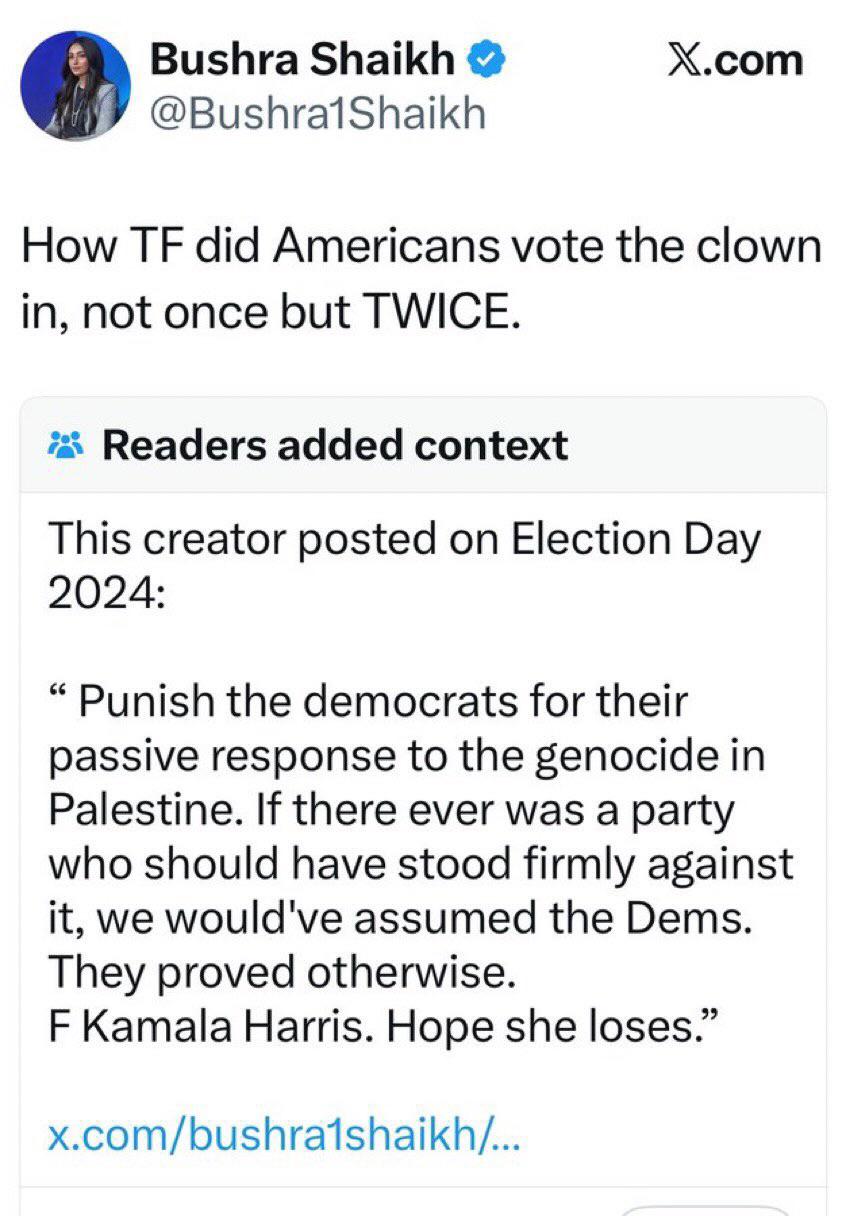
And I don’t subscribe to the ideology of all or nothing. “Better to compromise all values than only some.” Genocide wasn’t on the ticket. Other issues were. If your deeply held conviction is that ICE and all this shit (including genocide) is better than the alternative, I think your priorities are fucked.
This isn’t about shame, it’s about trying to find a strategy for tackling this shit (liberalism, capitalism, fascism) effectively. We want the same thing, we just don’t agree about the methods, that’s what I’m trying to make a case about: Build progressive support from the ground up, where the stakes aren’t as high, delay the dismantling of liberties and privacy that would make resistance and change harder, vote anti-fascist to buy time to organise resistance.
Who gets to decide what’s on the ticket and what’s not? The party?
I swear, I don’t understand at all why you people complain about one-party states. If the Democrats can simply decide that we don’t get to vote on whether or not to keep doing genocide, and, furthermore, that it is fundamentally impossible to change out that party for something better, then the thing that separates the US system from a one-party state is that we also have a brazenly fascist party looking to undermine democracy at every turn. Tell me, is the presence of the Republican party the thing that makes the US system more democratic?
This is just once again asserting this ideological framework of lesser evilism that I reject.
God, I hate that phrase.
You’re “buying time” at the cost of directing frustrated energy and momentum straight back into the existing political framework. That’s completely counterproductive. You don’t even want people to voice their opposition to the existing parties, much less to the system in general, even in a presidential vote that, for the vast majority of Americans, not living in swing states, is a meaningless symbolic gesture anyway.
This “buying time” rhetoric is just about trying to appease dissatisfied people with the fantasy that people are going to spend that time organizing as opposed to going straight back to brunch. It’s nothing but procrastination.
In so far as the party chooses the candidate to put on it and the platform they run on, yes. Unfortunately, both major parties’ leaders are genocidal and rather set in their ways. Rig primaries, ignore popularity of progressive candidates, you know the deal.
In one-party states, democracy has already been hollowed out, so in a roundabout way:
It signals that there is still some democracy left to undermine. However, if the Republicans were wiped off the electoral map, people could still vote third party, form a progressive opposition and attempt to wrest control of tne Democrats thay way, while a one-party state wouldn’t even have that option. Granted, handing the Democrats full control would be a bad idea too, but it serves as illustration.
Maybe I’m just fundamentally misunderstanding what your moral framework actually is.
Once they start committing crimes, you stop caring how many they commit, because at that point it’s all just evil? Your response to the Trolley Problem wouldn’t be “I divert it to save lives” or “I refrain because I can’t condemn one person to death”, just “What does it matter? People die either anyway.”
Is “voted for someone who would have supported genocide” a worse offense than “DOGE gutting government agencies, ICE terrorising citizens, illegal tariffs sabotaging economy to the detriment of the people, participating in genocide, murdering civilians to drive up oil prices, all the while attempting to ensure that nothing - no vote, no protest, no attempt at insurrection - will ever stop this or pry loose the claws of the winners of capitalism, but at least I get to wash my hands in innocence”?
Because then I will agree with those who think your ideology is stupid, not for its motives but for its short-sightedness. If it is more important to you that you have a pristine conscience than that all the people fucked over by this regime, then I hope the moral high ground protects you from leopards coming to eat your face.
I think you have confused me with someone else, because I very much criticise this system as being fucked, which is also why I advocate for building support for change from the bottom up: A new system needs to be set on a foundation more solid than “lesser evil”. In local, municipal, primary elections, expressing support for progressive candidates is crucial, because the stakes for losing to the Spoiler Effect are generally less severe…
…except in a presidential vote in a system that is way too top-heavy anyways.
If it makes no difference, absolutely, vote third party for the visibility, so long as you vote at all. Political analysts can only guess what non-voters want (or whether they just couldn’t vote), which makes apathy the worst illness to democracy: If you vote for something else, your vote at least expresses what you want rather than what you don’t.
Then what do you call inaction? Or are you hoping it gets so bad people start revolting, but not so bad they can no longer revolt?
So in your mind, the thing that makes our system more democratic than a one party state is what would happen if the Republican party disappeared one day, but also, it’s also impossible to change from the current party system?
I have absolutely no idea how you got there, other than trying to read my position in the least charitable way possible. Humor me, why did you conclude it would be that rather than “I refrain because I can’t condemn one person to death?” My reasoning for not voting for Harris is that I refuse to enable one population to be genocided.
If you want to understand my moral framework, I’m a rule utilitarian. In fact, while I consider either position defensible, I would pull the lever in the trolley problem. However, that’s only because of the constraints of the hypothetical, constraints which make it not applicable to most real world situations, and particularly not this one.
This “trolley problem” situation did not come about accidentally. Democrats are partially responsible for upholding the system that forces us into this situation. What’s more, they have also funded far-right candidates (including Trump himself) because they believe they will be easier to beat - that they can essentially use them to force people to vote for them even if they offer nothing (the infamous “pied piper” strategy). This engineered, coercive element, and the element of rewarding the people who engineered the situation, and the element of the problem being repeated, none of those are present in the trolley problem, and they fundamentally change the question.
When Putin sent troops into Ukraine, the quickest path to peace, to minimize bloodshed, would have been to negotiate an agreement even if it meant territorial concessions. All the people who are constantly talking about voting for the lesser evil seem remarkably willing to accept an outcome where more people die. Why? Because, they argue, if we don’t fight him here, he’ll just keep pushing further and further. Because we have to make sure that he is punished, or at least not rewarded for engineering such a situation. Instead of just looking at “which option directly minimizes the loss of life,” you also look at what precedent you’re setting on a broader scope. Everyone has a hill they’ll die on.
Or if you’d prefer, there’s a relevant Star Trek episode that examines that sort of question.
I am simply applying the same framework domestically. If you try to force me into a situation where I have no choice but to support you and give you power, then I’m going to tell you to fuck off even if it means accepting a worse outcome in the short term. If they learn that they can get away with all this stuff, funding far-right candidates, maintaining an undemocratic system, literal genocide, and I’ll still fall in line, then what incentive would they ever have to refrain from such tactics? It is precisely because the left has historically been willing to accept lesser evil candidates that they thought they could push this far in the first place.
What an incredibly backwards criticism. My perspective is looking much more at the long term than yours is. You’re looking solely at the immediate outcome of the election, I’m looking at how to either force the Democrats to adopt better positions or how to build a new party capable of posing a realistic threat. I didn’t expect either of those effects to happen last election, I don’t really expect them next election either. But I’m in it for the long haul, I will keep voting third party unless and until they cave to my core demands (and if “no genocide” is not a reasonable core demand, then nothing is). They need our votes as much as we need them and I’m not going to be the one to flinch first in this game of chicken. Not when the stakes include genocide.
Are you not making a moral argument right now? Talking about “more important to have a pristine conscience” is meaningless then. If I didn’t care about having a clear conscience, then why would I vote democrat even if I accepted that that was the moral position? You vote democrat because it’s what you believe is right, what gives you a “pristine” conscience. Unless you’re going to start arguing based on nihilism or something, you can leave that nonsense at the door.
I don’t support inaction.
Please stop putting stances into my mouth that have nothing whatsoever to do with anything I’ve actually said. I am not an accelerationist, accelerationism is stupid and wrong. If I were an accelerationist, wouldn’t I be arguing for voting for the worst candidate instead of third party?
It’s possible to shift political balance, but not starting from the top.
“I don’t believe in a lesser evil”, to me, implies equalising all kinds of evil.
If we twist the dilemma to apply it to the question of US presidency, the single person would be tied up before the switch, and so would be condemned either way; the choice of switching would be whether to let it run over five more people.
In that context, my understanding is that you feel pulling the switch would make you culpable for engaging with a system that kills a person. My argument then is that pulling it wouldn’t be enabling a genocide, because that first person is beyond your power to save. It’s all the other people you’d pull it for.
But my frustrated assumption that it’s just about washing your hands in innocence stands corrected. Sorry about that. I also didn’t previously realise that you do vote, just third-party. That is a difference from the apathic “why bother voting” rhetoric I see in that context.
My worry with that approach is that this plan may be too long-term. That, in the attempt to save democracy, you’d let a regime seize power that proceeds to dismantle democracy. When Trump’s campaign includes the promise that you’ll never (“have to”) vote again, attempting to use votes as leverage is gambling whether they will have any value as leverage when the next election comes around.
It absolutely is. My argument was that it shouldn’t be the only one.
Advocating for compromise forms a knot in my stomach. It’s a strategic concession that the situation they have engineered puts them in a position where I feel like it’s dangerous to refuse their demands. When they’re essentially holding democracy hostage, I do negotiate with terrorists and hope to keep the hostage safe until a proper rescue operation is underway. My conscience is about as pristine as having waded into a sewage pit to try and save something worth more than cleanliness.
The “Pristine Conscience” option would be to advocate for general strike, civil disobedience, protests so encompassing that not even the “peaceful protests don’t work” fraction can deny the destructive power of “fuck you, I won’t do what you tell me”. Imagine grocery store employees collectively handing out food for free, Utilities’ employees refusing to turn off utilities for people that don’t pay their bills, truckers blocking police stations…
That option becomes untenable the second you remember toilet paper or see rules on how much gas you’re allowed to hoard.
Either way, I’ll gladly be a cynic in error. If your approach turns out fruitful, we’ll all be better off for it. I just hope we live to see that long run.
In my view, Trumpism is not a spontaneous thing that came out of nowhere and might disappear just as easily, but rather something that emerged as a natural result of declining material conditions. You can’t hope to just weather the storm, because it’s not just Trump as an individual, and when Trump is gone whoever the right turns to will be just as bad, if not worse. Furthermore, as things stand, they will continue to gain power over time and will become an inevitability. This inevitability is caused by two things.
The first is the tendency of the rate of profit to decline. In regular language, what that means is that as an economy gets more developed, the number of untapped, productive ventures shrinks, it becomes harder and harder to make profits through the development or expansion of productive industries. That’s why we get things like the enshittification of the internet, because companies have to find ways to increase their profits and if there’s no more room to grow, all you can do is squeeze customers more. This is the general, overarching cause of economic decline.
The second part of the inevitability of the far-right is that they are the only ones who are positioning themselves as an alternative to the existing status quo. Liberals are very much wed to the existing system, and they do their best to shut down any leftist voices calling for change.
Now, what happens when you have an economy that is declining because of fundamental structural reasons, and the options are sticking with that forever, or… the Mystery Box? People are going to chose the Mystery Box. And as it stands, the only Mystery Box out there is fascism. Now, we could offer our own Mystery Box, but any time we endorse a status quo candidate, we discredit ourselves as actually being distinct from the status quo. We are telling people, “This is acceptable, this is good enough” even when we know that’s not true, and as a result, when they fail they drag us down with them and discredit our messaging.
Because I see defeat as a near-certainty in the long term, I am willing to accept risks of the whole thing blowing up in the short term in an effort to avert that. There is no gamble if we were doomed anyway. If it is a political impossibility to actually address the structural problems, then we at least have to provide alternative explanations and an alternative vision. We have to hold a candle in the darkness, even if all we accomplish is guiding a few lost, confused souls towards the truth and away from the enemy.
The ship is sinking, and I’m saying, “We have to plug these holes,” and the liberals respond, “It’s actually really antisemitic for you to say the holes exist, and if you try to fix them we’ll break your legs.” And so, what can I do except rip planks off so I at least have something to cling to when it all goes down?
Holy shit, I love that analogy.
All in all, I mostly agree with your comment. I also advocate for third-party voting, like I said before, to signal what you do want. I don’t believe that defeat is inevitable, and I agree that structural change is necessary, whether by propping up the progressive wing within the Democratic Party or by propping progressive movements outside of it.
Our disagreement on methods is effectively just about the federal level in swing states, where I believe that the risk for a Spoiler Effect and stakes for loss are too high to justify the signalling value, particularly since the Dem leadership seems to habitually (or intentionally) “misunderstand” any close call and run away in the wrong direction instead of figuring out how to win votes.
Hence my suggestion to build the foundation for that change from the bottom up: You won’t topple the tip while its base stands firm, but if that base starts shaking or shifting, the top will have to follow.
This is where my grudge lies primarily with the (voluntary) non-voters, as well as those who advocate for not voting at all, which is also why my understanding of your position fundamentally pivoted when I realised that that’s not actually your stance. To vote third party and send a signal is far more valuable than to not vote at all. It is a form of protest, rather than indifference.
Our disagreement is a nuance, but in the end, we want the same thing, and I respect your stance and integrity all the same.
Thank you, I’m glad we could reach an understanding.
My view on that is that voting in a presidential election (especially if you’re not in a swing state) is primarily performative and an expression of loyalty, rather than actually influencing the outcome. The presidential race is, unfortunately, the only thing anybody cares about. I voted for democratic candidates in downballot races, where my vote is far more likely to matter, but nobody I talk to cares about that, at all.
The fact that this is the way that everyone engages with politics and forms their political identities makes me see it as all the more important to make a point of voting third party in presidential elections, as part of defining myself and my positions as distinct from the democrats. I sometimes feel that people use the talking point of third parties starting small in local races as a way to shove them into something they don’t give two shits about so they can stop thinking about them entirely. Because presidential races are such a spectacle, the primary way in which people engage in politics, I view it as necessary to engage with them on that front.
If someone makes a big deal out of my third party vote (particularly in a safe state, like most Americans), that’s a clear sign to me that their perspective is all out of whack. And conveniently, they tend to come at me for it, which gives me a perfect window to criticize their views.
This “team loyalty” shit beyond all nuance and reason is a blight anyway. If it wasn’t stupid enough in sports or fandoms, it definitely would be in politics.
I wish third parties had received more visibility and significance long before this crap got so out of hand. I also wish FPTP would become an important part of the history of democracy, as a case study how enfranchisement alone doesn’t make a fair democracy, with the emphasis being history as in “no longer present”.
I feel like caring about elections at every level is a civic responsibility, and it saddens me to see that many people are so apathetic about it.