
Crossposted from https://fedia.io/m/[email protected]/t/4518262
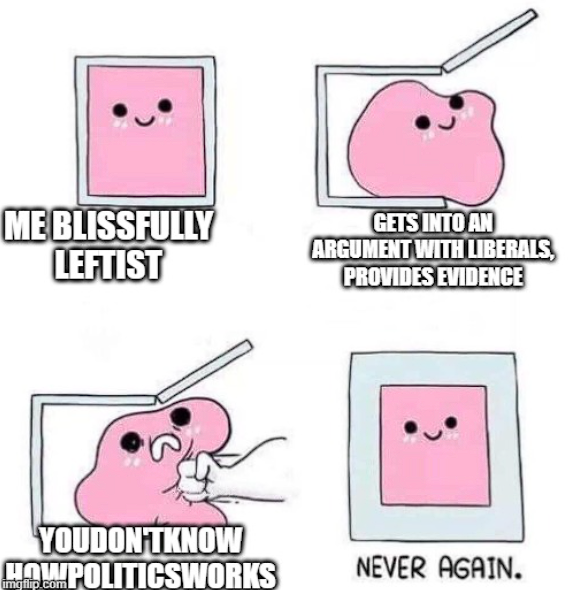
Inspired by this thread where at least five different libs made the same point and responded the same way when I tried to poke their bubble. Seriously CTRL+F my username or the word “voter” it’s downright surreal. The hivemindness of the affair was also pretty weird, but I’m not one to meme the same interaction twice.
Yeah, so like I said, that comes from the economic pressure built up by merchants who were free to go make their fortune but not free to buy power and change society. A lot of liberal theory was developed from observing charter cities, which were places rich merchants and bankers built after they convinced a king to sell them a charter to a piece of land. They created all sort of new ways of operating on this theory of self-determination. Except it was only positive self-determination for the rich and landed. The workers were “self-determined” in that they could choose which abusive rich merchant they could work for.
This is what I mean. Liberalism is internally contradictory because self-determination and private property are diametrically opposed when you scale them up. Claiming natural right to murder anyone who steps foot on a piece of land, and to pay people to do that murdering for you, and to pass that right down through inheritance, or sell that right to the highest bidder, is only self-determination for the minority. For the majority of people, their lives are determined by what the ultraminority rich allow them to have, and of course the smartest move is for the ultraminority rich to collaborate, even without direct and explicit coordination, in making sure the majority are always weak, divided, focused on their own survival, and fighting each other instead of the rich.
That’s liberalism, from the beginning. It’s never been anything except that.
Oh, don’t worry, I understand exactly why you’d like to keep the conversation focused on economics and not consider at all what it means for the mechanisms of state oppression.
I don’t think you do, actually. Liberalism has a very bloody history of state repression whenever it took root. 100 - 150 years of abject poverty of the masses resulted in the labor movement and gave birth to Marxism because liberal state repression was just that devastating.
Remember, private property rights are enforced by the state. They are not natural in any way. They are legal fictions created by and enforced by the state on behalf of the minority of owners.
sigh
If you’re going to use the original definition of conservative, why do you insist on not using the original definition of liberal?
You’re not making any sense. I am not using a “definition” of liberal or conservative. I am explaining the political philosophy of liberalism and conservativism. There was never a time when Liberalism meant “self determination” and wasn’t also inherently tied to private property and wealth. Either you have a problem evidenced by your use of the word “definition” (in that you think there is a dictionary definition of a word and that dictionary definition is what matters, in which case you’re wrong about that and you’re also wrong about the definition) or you have a problem evidenced by your use of the word “original” (in that you think there was a Liberalism that existed prior to all other Liberalism which meant the universal liberation of all for self determination and it had no concept of private property or wealth, in which case you’re also wrong)
So if you’re going to claim that there is an “original definition” of Liberalism that I am not using, you’re going to have to make the historical argument for that instead of just repeating yourself that I am not adhering to an authoritative canon. I have done what I could here to explain the historical origins and development of Liberalism. You will need to present an actual challenge.
I wouldn’t say you’re explaining political philosophy at all. I think you’re explaining economic policy.
There is also liberalism that is not tied to economic policy. Mostly because the economic framework you ascribe to it did not exist for…roughly a century.
You’re being deliberately obtuse. Economics is a subset of politics. Liberalism emerged because of the politics of economics. Merchants were engaged in large scale international trade that was historically large in the 1400s. Liberalism as a term was coined after the political philosophy had been articulated, and it was articulated by John Locke in the late 1600s. Common stock and stock exchanges were emerging at the same time.
Your problem is that you think liberalism was exclusively an ideal of self-determination. But it was not. That self-determination had a material manifestation. Title to land would still exist under liberalism, but without a monarchy and without an aristocracy, title would be distributed via the free market. Self-determination under liberalism included over one’s property. Because property is where power was to come from under liberalism. Because where else would it come from and still be self-determined? Power couldn’t come from the government, because that wouldn’t be self-determination, even if that government was a democracy.
So a democracy for the parts of government that were necessary, but government was to be doing nothing except protecting “rights”, and one of those “rights” had to be the right to private property, or you couldn’t replace the functions of the monarchy with the functions of the merchants. Because one of those “rights” was private property, the government’s job was to protect the property rights of the property owners. And because of that, liberal democracies were never born with universal suffrage and almost all early liberal democracies limited the franchise to property owners - because the majority would use their power to compel the government, in their name, to strip the wealthy of their property.
You haven’t provided any historical context for your claim that the “original definition” of Liberalism was “self-determination”. You have, however, seemed to indicate that maybe you don’t know the history of Liberalism, political philosophy, and political economy?
Please provide some support for your claims.
You know that there are writers other than Marx, right? And that pretty much the entire philosophical world of the 17th and 18th century debated liberalism without Marxist economic analysis?
So you have nothing to talk about? You have nothing to say? Nothing to draw upon? You have no authors, no works, no timeline, no analysis, nothing? Just weak attempts at trying to argue about the argument instead about the contents of the argument?
Yes, of course Locke was writing before Marxian analysis. Of course Burke was writing before Marx. Of course Ricardo and Adam Smith were before Marx.
None of that is relevant to the analysis I have put forth.