
Crossposted from https://fedia.io/m/[email protected]/t/4518262
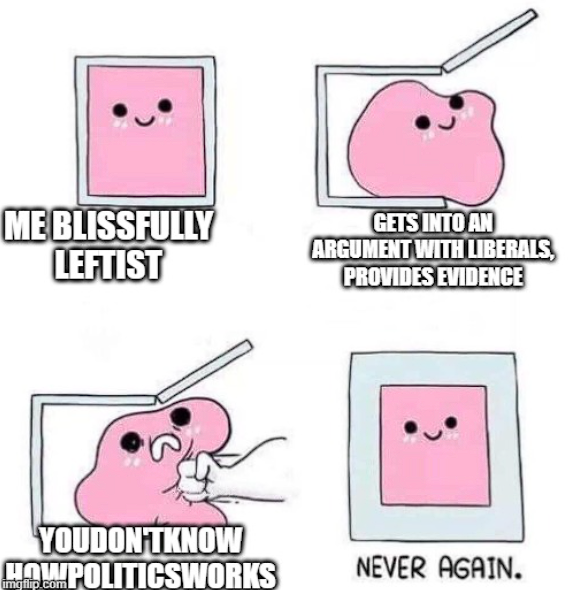
Inspired by this thread where at least five different libs made the same point and responded the same way when I tried to poke their bubble. Seriously CTRL+F my username or the word “voter” it’s downright surreal. The hivemindness of the affair was also pretty weird, but I’m not one to meme the same interaction twice.
You’re being deliberately obtuse. Economics is a subset of politics. Liberalism emerged because of the politics of economics. Merchants were engaged in large scale international trade that was historically large in the 1400s. Liberalism as a term was coined after the political philosophy had been articulated, and it was articulated by John Locke in the late 1600s. Common stock and stock exchanges were emerging at the same time.
Your problem is that you think liberalism was exclusively an ideal of self-determination. But it was not. That self-determination had a material manifestation. Title to land would still exist under liberalism, but without a monarchy and without an aristocracy, title would be distributed via the free market. Self-determination under liberalism included over one’s property. Because property is where power was to come from under liberalism. Because where else would it come from and still be self-determined? Power couldn’t come from the government, because that wouldn’t be self-determination, even if that government was a democracy.
So a democracy for the parts of government that were necessary, but government was to be doing nothing except protecting “rights”, and one of those “rights” had to be the right to private property, or you couldn’t replace the functions of the monarchy with the functions of the merchants. Because one of those “rights” was private property, the government’s job was to protect the property rights of the property owners. And because of that, liberal democracies were never born with universal suffrage and almost all early liberal democracies limited the franchise to property owners - because the majority would use their power to compel the government, in their name, to strip the wealthy of their property.
You haven’t provided any historical context for your claim that the “original definition” of Liberalism was “self-determination”. You have, however, seemed to indicate that maybe you don’t know the history of Liberalism, political philosophy, and political economy?
Please provide some support for your claims.
You know that there are writers other than Marx, right? And that pretty much the entire philosophical world of the 17th and 18th century debated liberalism without Marxist economic analysis?
So you have nothing to talk about? You have nothing to say? Nothing to draw upon? You have no authors, no works, no timeline, no analysis, nothing? Just weak attempts at trying to argue about the argument instead about the contents of the argument?
Yes, of course Locke was writing before Marxian analysis. Of course Burke was writing before Marx. Of course Ricardo and Adam Smith were before Marx.
None of that is relevant to the analysis I have put forth.
sigh
https://lemmy.zip/post/74251331 edit: damn I can’t link specific comments.
“Analysis” isn’t the word I’d pick. “Regurgitation” seems more accurate. And you seem annoyed that I’m doing anything but asking for seconds.
I never said that Liberalism was created for the purpose of upholding an economic system that did not exist. You said I said that. I then explained my position with a specific focus on exactly the question you raised of politics, economics, and historical timeline.
You, however, have done nothing to support your position that “the original definition of Liberalism is self-determination”.
So not only have completely failed to engage my argument, you have also failed to make your own.
No, you just refuse to consider liberalism from a non-economic perspective. Normally, this is because someone is uncomfortable with anarchist principles and would prefer a more statist approach.
That’s why you’ve refused to answer my questions regarding why you don’t use the original meanings of liberalism throughout the 17yh and 18th centuries, and that’s why you exclusively discuss liberalism through the lens of an economic critique that came about over a century after liberalism itself was established throughout the Western world.
That’s also why I’m not much engaging with your argument: it’s irrelevant. It’s like suddenly talking about the biology of flamingoes and insisting you discuss it as well.
Again, you have made zero case for this supposed “original meanings of liberalism”. You have provided no authors, no texts, no movements. Nothing. You have provided nothing.
Instead you have decided to take the position that economics is as foreign to politics as the biology of birds. Which is a very telling position, in that it tells me you’re not only not serious about political theory but you’re also not serious about the discourse on politics that you claim to be referring to.
Do you think it’s strange that you insist that there is an original definition of the word liberalism but you refuse to discuss who defined it?
The word “liberal” emerges in the discourse with William Robertson, closely followed by Adam Smith. Strange that the word enters the discourse by people doing analysis of political economy.
Do you agree or disagree? Do you believe someone earlier than those two used the word liberal in a political sense? Do you believe that they meant something different than I am claiming? Or do you believe the context around the original use of the word “liberal” in the political domain is meaningfully different than the context around the original use of the word “liberalism”? If so, who would you cite to help me understand your position, which I will point out, you still have not provided any support for or detail of despite you having responded several times now?
So this is where I think you’re not aware of how indefensible your protestations are. The idea that we cannot use future frameworks to understand past phenomena is trivially refutable. For example, the discourse around liberal politics that uses the word “liberal” came after the philosophical and political discourse that founded what they then called liberalism. Marxism as a term is a term used after Marx published his ideas. We still call it influenza but we now understand germ theory and we can apply it to historical phenomena as much as we can apply it to future phenomena. The planets do not move differently simply because we change our models.
Likewise, liberalism is a historical phenomenon that can be examined today through the various lenses we have developed to understand history. That the lens we use was developed later than the thing we are examining through it is immaterial to whether or not the analysis is accurate and is certainly not grounds for a claim of logical fallacy.
Strictly speaking, you have also provided no authors, no texts, and no movements. I just happen to know that you’re relying on Marx.
Further, you seem confused as to the burden of proof: when you make a claim, such as “liberalism is economic coercion”, then you provide evidence to support that claim. I have repeatedly pointed out that your claim ignores all writings outside of Marx. You simply chose not to engage with that, asking me for proof. Proof of what? I didn’t make any claims, I challenged your claim of liberalism being exclusively economic coercion.
You want specific names? Sure. John Locke. Liberalism is (1) right to self determination (2) consent of the governed and (3) right to revolt.
Now, in my experience, people that refuse to engage with liberalism outside of economics tend to refuse to do so because ideas such as consent of the governed and right to self determination is antithetical to their statist views. Which also aligns with the published political ideology of .ml
I mean, at this point you’ve revealed that you’re not actually arguing with me but with some ghost in your imagination. I named quite a few people including Locke, Smith, and Robertson. I refered to several movements including mercantilism, Conservatism, and Liberalism. I never said that “Liberalism is economic coercion”, though you could imply that from what I said. You’d be wrong, but you could imply that. But the fact that you put those words in quotes, when it is not in fact in any of the words I wrote, is almost too on the nose for how you’ve been engaging here.
John Locke in his second treatise on government explicitly defined private property as a core pillar of the philosophy he was describing. The liberal revolutions around the world pre-Marx all relied on the Lockean discourse around private property.
And by the way, Locke didn’t call it liberalism.
At this point, I feel like I have shown clearly using your own words and claims how incorrect your position is, but let me reiterate:
In response, I cite Locke, who you also claim as the originator of liberalism, but I show that Locke foundationally defines his philosophy on private property and state defense of property rights. I also claim that the “original definition of Liberalism” was not put forth by Locke, but rather thinkers working 75 years after Locke looked at Locke’s work and called it Liberalism, and even those people who coined the term and refered to Lock were doing so from a political economy perspective.
I think that’s pretty thorough, but let me know what I’m missing here