Title text:
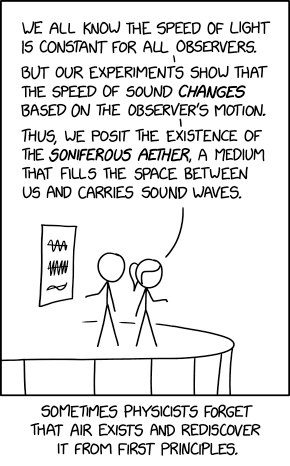
Imagine you could ride alongside a sound wave. It would probably be pretty cool, right? We’re putting in a departmental budget request to buy a really fast plane so we can check it out.
Transcript:
Transcript will show once it’s been added to explainxkcd.com
Source: https://xkcd.com/3238/
You must log in or # to comment.
Sound is funny. At lower frequencies it behaves increasingly similarly to air i.e. wrapping around obstacles instead of just reflecting. At 0Hz sound is just the local air pressure and the weather forecast is technically sheet music.
At 0Hz sound is just the local air pressure and the weather forecast is technically sheet music.
👌
Thought this was from the hover text for a second!
It’s an awesome comment, it totally could have been the hover text.
Stands to reason. Vivaldi did compose the seasons after all
!!! my oregano !!!
Speed of light in fiber is ~0.66c₀. Light is slowed down a bit by air, too. So…
That is not the speed of light through fiber. That is the speed of light bouncing at diagonal angles as it travels through fiber.

It appears to travel slower because it’s not traveling in a straight line. But I promise, every individual photon is traveling at exactly c. Photons emmited simultaneously will not all arrive at a destination at the same time, but this isn’t because they’re traveling at different speeds, it’s because they’re taking different paths, reflecting and refracting slightly differently.
Not really. Yes of course that is a relevant effect. But photons travel as slower speeds in different materials. Thats what the refractive index indicates of a material.
Edit wait I meant to post this to the other dude, sry. I’m just gonna literally double down.
In 1999, she led a Harvard University team who, by use of a Bose–Einstein condensate, succeeded in slowing a beam of light to about 17 metres per second, and, in 2001, was able to stop a beam completely.[2] Later work based on these experiments led to the transfer of light to matter, then from matter back into light,[3] a process with important implications for quantum encryption and quantum computing.
"refractive index”
Not to split hairs here, but that’s also kind of the same thing.
Like what does “refractive” mean? Does it mean moving slower or bouncing around?
In 1999, she led a Harvard University team who, by use of a Bose–Einstein condensate, succeeded in slowing a beam of light to about 17 metres per second, and, in 2001, was able to stop a beam completely.[2] Later work based on these experiments led to the transfer of light to matter, then from matter back into light,[3] a process with important implications for quantum encryption and quantum computing.
Well the name refers to the relative incident and internal angles because that’s what scientists first measured. The light slows down due to interactions with the electrons (mostly) in the material. It causes them to move which drags the light. You can model this as an interference from the light produced by the resulting electron movement. I don’t see that as bouncing, especially not like the bouncing on the internal surfaces of fiber optics. But obviously it’s not like anything we can tangibly understand, so whatever mental model works for you is cool.
That’s fair. Nearly everything at that scale is up for interpretation. I find that nothing in physics works the way it intuitively seems like it should.
Good explanation. It is the same with air, I guess. :)
Exactly, at least that’s my understanding!
I thought the majority of the slowdown was because of the refractive index of the glass, where the wave does actually travel slower through the fiber even if it was going in a completely straight line.
Individual photons still travel at exactly c, but there is an effect which I don’t understand that causes the light to slow down (I was taught that this was because light was absorbed and reemitted by the glass molecules but from googling it that’s not true)
So if I bend my internet tube in the right way I can get faster internet?
Get it just right, and yeah, lower latency. It’s not likely to change the bandwidth though. 😉
Do the individual photons slow down? No. But those photons get absorbed by atoms along the way and then a new photon of light is emitted (nearly, but not literally, instantly) which then continues along it’s merry way at C until it encounters another atom. What slows down is the net speed of transport through a given medium.
From my understanding, a fair amount of the “delay” is caused by the absorption and remission of photons, which takes time. The photon you measure at one end is often not the same photon that was sent. I could be wrong though, if anyone wants to let me know.
iirc light does move through the fiber itself at more or less 1c its just that it doesn’t take straight path due to all the internal reflections which is what causes the slow down.
c is speed of light in a vacuum. Light does go slower in other media. This is why refraction, among other things, exists. I’m not sure what the speed of light in fiber is, and it may be very close to c, but it will not be c.
Oh, so it is not about the indirect path? Light taking the direct path would still be slower than in vacuum? What slows it down?
It’s quantum mechanical, so the maths gets complex. It can be simplified in a useful way however.
Basically, atoms can absorb photons and then re-emit them. You can think of the photon flying past at C, but getting absorbed and emitted along the way, adding delays. In QM however, neat particles don’t exist, it deals with quantised, probabilistic waves. The above effect gets blurred over the waveform. No one atom definitely absorbs it or doesn’t, it gets blurred together into a general slowing of the wavefront.
Like toll booths on highways. Understood.
In QM however, neat particles don’t exist, it deals with quantised, probabilistic waves. The above effect gets blurred over the waveform. No one atom definitely absorbs it or doesn’t, it gets blurred together into a general slowing of the wavefront.
That’s exactly the amount of QM I can understand. Which means I don’t understand QM. ;)
QM isn’t insane to understand. It’s main issue is that it doesn’t map well/at all to our normal experience. You need to dive into the maths, and accept what falls out.
The main deeper level here is how the blurring happens. The photons explore all possible paths. The result is an integral of them all. In general, vast areas cancel out, leaving classical (ish) behaviour. This makes sense mathematically, but has no classical analogy to compare to.
The darkness is thicker on earth than in space.
:D
I haven’t looked into it recently, and the only answer I recall is “because”. Ultimately, the higher the refractive index, the slower the speed of light in that substance. As for fiber optics, the 0.66 c, which isn’t a claim I made, could be in part due to reflection increasing the path length, or it could be net speed including repeaters/amplifiers, or something else.
Repeaters and refraction explain a lot. The remaining slow down of light - if you factor those effects out, feels a bit magical. The effect isn’t as big as on Pratchett’s Disc World, but the air actually slows down the light. And fiber does too.
Light is so oddly affected by magic, as it passes into the Disc’s atmosphere, it actually slows down from millions to hundreds of miles an hour. One odd effect of this is that the Disc has time zones, when, as a flat world, it shouldn’t. Another effect is that, as reported in Thud!, the red- and blue-shifting of light becomes noticeable when travelling at speeds of merely a hundred and twenty miles per hour.
Well, it’s an explanation!
The soniferous aether was known as akasha in ancient vedic philosophy. Akasha was the tattwa of “space” and functioned like a quintessence in that system, basically being the first tattwa produced by the exhalation of Brahman, from which the other four tattwas are subsequently formed.
The tattwa of air was vayu, the odoriferous aether
Then there were also apas, prithivi, and tejas (water, earth, and fire); each aether assigned to a different sense (taste, touch, and vision).
Basically, the way akasha would form into the other aethers was by slowing down vibrationally (the snake was a common symbol for vibration, especially in the Kashmir region, and is very much associated with the iconography of Shiva the Destroyer). So if akasha was the fastest vibration, next was tejas, then vayu, then apas, and finally prithivi.
Akasha was said to be egg-shaped, tejas triangular, vayu circular, apas crescent-shaped, and prithivi square. Thinking about how each state of matter behaves, this makes sense as far as early intuitions go.
So even though from the standpoint of modern science, we know these are not the real building blocks of the universe, I find they are surprisingly close to accurate for something that was theorized thousands of years ago. Closer than their western counterparts, certainly, although there are some interesting similarities if you want to pick those apart (try starting with Plato’s Timaeus, for instance).
But ultimately, even though they didn’t have electron microscopes to actually confirm or disprove their theories, they got a few things right: 1) Atomism, or the basic building blocks of the universe being tiny, unseeable particles that everything else is constructed from; 2) States of matter are made from the same materials, only vibrating at different rates; 3) The five main human senses are determined by interactions with matter as a medium of energy transference.
There are probably more, but these are the main ones. For instance, when you dig into the shapes of the tattwas you see how the spherical nature of vayu gives it the properties of taking on the size and shape of its container; the tetrahedral shape of tejas causes it to rise and expand; the crescent shape of apas causes it to fall, cohere, form droplets, and take on the shape of its container; the square shape of prithivi causes it to hold its form, stack and tumble, and generally behave as solids do.
The shape of akasha is a bit more of a mystery because how do you truly describe the shape and behavior of empty space? But ultimately it makes sense within the system, because space is the “cosmic egg” within which the embryo of the universe is nurtured (theoretically, when it “hatches,” this is like Vishnu waking up from the dream; cosmologically similar to the “inhalation of Brahman,” when everything returns to Source).
Atomism wasn’t correct though. Atoms aren’t indivisible and they’re not the smallest unit reality has.
“States of matter are made from the same materials, only vibrating at different rates.”
Well yes, but they only identified one material correctly, water. And us being mostly made of it and our planet being quite blue, and water being water, quite obvious.
The five main human senses
That’s a common myth, but it’s a misconception stemming from history and not anything any actual neuroscientist believes. We don’t have 5 senses. We have like 10 to 20, they’re still arguing about it. But here’s the main six and theyre thresholds (ofc everyone knows these ones but the thresholds seem quite interesting, and believable, like in a “yeah I could do that” way)

And a bit of copypaste from Reddit where someone has nicely listed these…
The extended series of senses.

Pressure

Itch

Temperature

Pain

Thirst

Hunger

Direction

Time

Muscle tension

Proprioception (the ability to tell where your body parts are, relative to other body parts)

Equilibrioception (the ability to keep your balance and sense body movement in terms of acceleration and directional changes)

Stretch Receptors (These are found in such places as the lungs, bladder, stomach, blood vessels, and the gastrointestinal tract.)

Chemoreceptors (These trigger an area of the medulla in the brain that is involved in detecting blood born hormones and drugs. It also is involved in the vomiting reflex.)
So yeah I read some of your comment, I can see how those can be interesting metaphors when you’re into that literature, buuut… that’s about it.
Physicists really reinventing “air” and calling it a breakthrough 😅