The messaging is there to keep people from leaving.
they’ll be told things like “that person was rude to you becuase you’re a Christian!” or “you lost your job because you were a Christian!” or any of a dozen things that have nothing to do with. (sometimes, in point of fact, they push you to do things that will make people angry at you. like knocking on their door at seven AM on a fucking Sunday. this is, for example, the point of the Mormon’s mission… or JW’s.)
along with all this, they’ll get you to burn bridges with your support systems; and to annoy everyone around you.
The whole goal is to keep you from leaving, even though they’re incredibly toxic.
Literally everything organized religion does is a psy-op to manipulate people 😅
I think it’s an interesting discussion to be had, whether it’s done by “the wealthy”. We have account that Jesus was kinda against the rich. I mean he flipped some tables and everything. And young Christianity also had something going on with the camel and the needle’s hole. And we have more paragraphs than just John and Timothy… But boy did they turn that upside down with what we have as of today. Especially in the USA. I think “they” accomplished their goal. Interesting, though, how the establishment (in modern times) often comes with some urge to claim victimhood. And I don’t think it’s traditionally part of totalitarianism.
so… Jesus wasn’t actually against the rich nearly as much as people make him seem these days.
The flipping of the tables wasn’t that they were doing business or even taking advantage of people. it was that they were doing business inside the temple.
as for all the “go sell your shit and follow me” stuff… well. yeah. Imagine, if you will Jesus with a cheesy sleazey-car-salesman grin and his hand out. Also notice that he really had a thing for hanging out with rich people.
none of the disciples were particularly poor. Mathew was a tax collector. James and John were both heirs to a successful fishing business, two of the others were senior employees in that business. he dined with and partied with the rich all the time, too. Joseph himself would have been well off (as a tekton, he wasn’t exactly poor. He was the guy that built everyone’s homes and such.) (though Mary probably fled from Joseph when he found out she was preggers. details)
basically, he acted and sounded like every half-baked cult leader you can imagine.
he was angry they were charging a bit extra for a bit of extra service. the money changers were presumably vetted by the Temple so they weren’t outright cheating their customers. the whole reason the temple required the tributes to be in silver shekels (or half shekels) from Tyre was that Tyre was known to not debase their currency; and the money changers would easily vetted to avoid the ones clipping or outright forging coins.
As for the livestock merchants, keep in mind there were (are?) stringent requirements for sacrifices that made bringing animals from outside the city difficult to do. These were not the goats being raised to be put into a stewpot. Even just raising them for sacrifice was expensive. Bringing them into the city was another expense. Keeping them in the city, too.
It’s very easy to imagine that Jesus was just being like “I can buy goats back home for (whatever a generic goat was worth)! These are ripoffs” and then going full-karen, while being too stupid to understand all that.
And I’m guessing if we were talking about anybody else who did similar, you would too.
First off, lets address the whole “people couldn’t worship because it was too expensive thing”, the law Jesus supported and said was eternal in Mat 5:17-20 makes it pretty clear if you cannot afford the prescribed sacrifice, you can give a lesser one in it’s stead (so like doves or even grain,) If you can’t even afford a grain offering, you don’t actually need to do that.
So there’s already a remedy in place for the destitute, and it’s pretty simple. (Side note, does that suggest Jesus and his followers overrode that? yeah. that’s a dick move.)
The other thing is that it was absolutely about location. Because evicting the merchants and money changers would not solve the prices it was effectively a captured market. there was a lot of demand for those services and animals. the merchants and money changers had the supply.
So if you make them go <over there>, they’re still gonna be dicks charging whatever they’re charging. and it’ll be less convenient, too, and chances are extremely high that your piligrims and worshipers, the people you seem to think Jesus was protecting- would be getting conned and scammed. Which just makes things worse for everyone.
Further more, Jesus didn’t just flip tables. He violently assaulted the merchants in a toddler rage. And yes. I would consider that to be wrong, immoral, and perfectly in line with the character of the real Jesus. The Jesus who wasn’t divinely born, who wasn’t the son of god, and who was running around the nether-regions of the ass-end of the empire conning rubes and yokels out of their stuff.
Yes. Was 380 when Christianity became state religion in the Roman Empire. I believe that was also when they had all these councils to codify what’s in the New Testament etc. I remember some notable exceptions from history class, like the Nazis. Some shenanigans between the Catholics and the Protestants, the French Revolution, Communism… But other than that, they’ve mostly been at the giving end during the 1646 years after that.
The edict of Milan, legalizing (ending official persecution) was in 313.
Unofficial persecution might have continued in pockets, but also it’s reasonable to believe that persecution was far from universal going into the fourth century.
All Jewish authorities in the first century were far less persecutial than the scriptures claimed - and Rome probably saw the matter as a domestic dispute (“bruh, just don’t start a rebellion and your cool”) until they started spreading out from Judea.
Most of the deaths of disciples are recorded in apocryphal works that are more fantasy than not. (Or just made up wholesale by people like Eusibious)
It’s not even very good at being that. There is a lot of misinformation, events that are provin false by other historical data and self-contradiction within its pages.
I meant historic document as in a document written at a moment in history, not necessarily an accurate historical account.
Like, Homer wasn’t a historian, but a historian specializing in ancient Greece would certainly read Homer to glean an idea of the beliefs, values, and ideals of the people during Homer’s lifetime.
Modern christians don’t even view the bible as a collection of documents that were written within specific contexts at specific moments in history, they try to remove it from all context and interpret it in a vacuum as if it was all equally applicable today


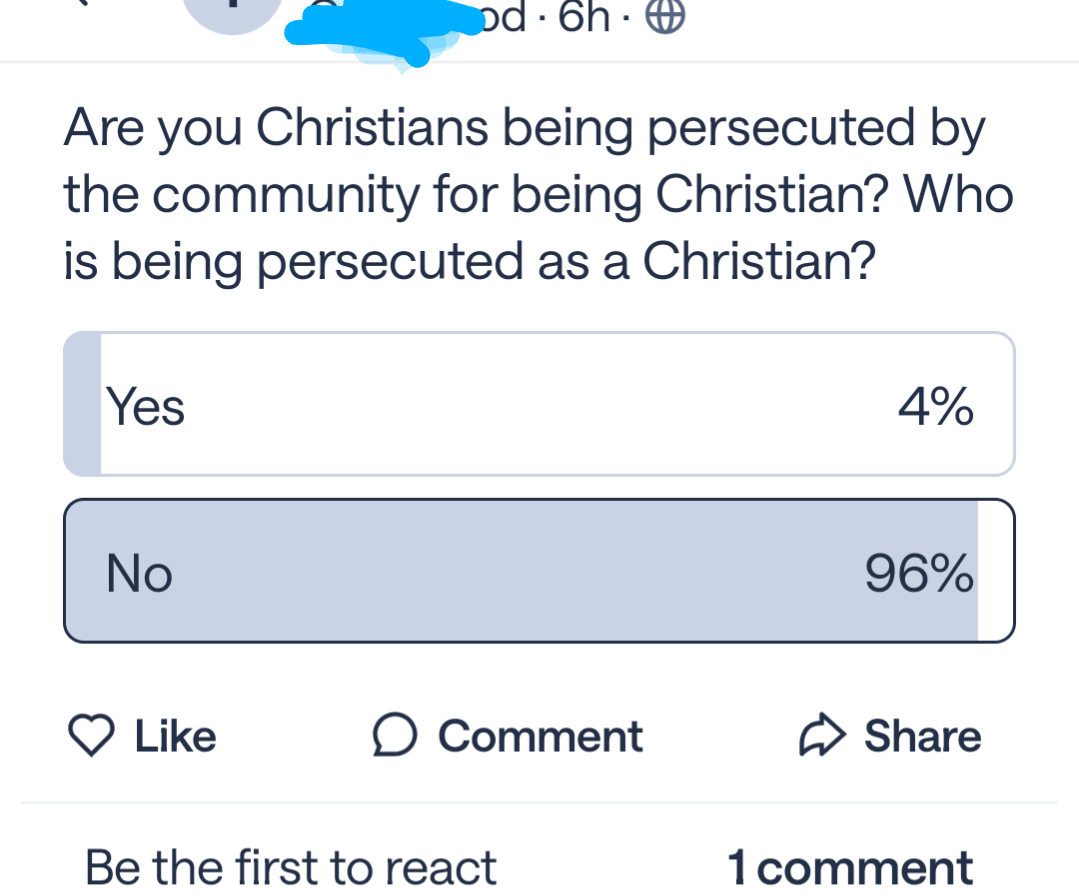
It’s a known phenomenon: https://en.wikipedia.org/wiki/Christian_persecution_complex
Though seems to me that persecution narrative must be pushed top-down by a minority, if 96% of the actual people vote “No”.
It’s seems like a psy-op by the wealthy.
not… well. maybe it is. but not directly.
The messaging is there to keep people from leaving.
they’ll be told things like “that person was rude to you becuase you’re a Christian!” or “you lost your job because you were a Christian!” or any of a dozen things that have nothing to do with. (sometimes, in point of fact, they push you to do things that will make people angry at you. like knocking on their door at seven AM on a fucking Sunday. this is, for example, the point of the Mormon’s mission… or JW’s.)
along with all this, they’ll get you to burn bridges with your support systems; and to annoy everyone around you.
The whole goal is to keep you from leaving, even though they’re incredibly toxic.
Literally everything organized religion does is a psy-op to manipulate people 😅
I think it’s an interesting discussion to be had, whether it’s done by “the wealthy”. We have account that Jesus was kinda against the rich. I mean he flipped some tables and everything. And young Christianity also had something going on with the camel and the needle’s hole. And we have more paragraphs than just John and Timothy… But boy did they turn that upside down with what we have as of today. Especially in the USA. I think “they” accomplished their goal. Interesting, though, how the establishment (in modern times) often comes with some urge to claim victimhood. And I don’t think it’s traditionally part of totalitarianism.
so… Jesus wasn’t actually against the rich nearly as much as people make him seem these days.
The flipping of the tables wasn’t that they were doing business or even taking advantage of people. it was that they were doing business inside the temple.
as for all the “go sell your shit and follow me” stuff… well. yeah. Imagine, if you will Jesus with a cheesy sleazey-car-salesman grin and his hand out. Also notice that he really had a thing for hanging out with rich people.
none of the disciples were particularly poor. Mathew was a tax collector. James and John were both heirs to a successful fishing business, two of the others were senior employees in that business. he dined with and partied with the rich all the time, too. Joseph himself would have been well off (as a tekton, he wasn’t exactly poor. He was the guy that built everyone’s homes and such.) (though Mary probably fled from Joseph when he found out she was preggers. details)
basically, he acted and sounded like every half-baked cult leader you can imagine.
Jesus was mad at those using the temple for commerce but also said they were robbing people. “Den of robbers” It wasn’t just the location.
he was angry they were charging a bit extra for a bit of extra service. the money changers were presumably vetted by the Temple so they weren’t outright cheating their customers. the whole reason the temple required the tributes to be in silver shekels (or half shekels) from Tyre was that Tyre was known to not debase their currency; and the money changers would easily vetted to avoid the ones clipping or outright forging coins.
As for the livestock merchants, keep in mind there were (are?) stringent requirements for sacrifices that made bringing animals from outside the city difficult to do. These were not the goats being raised to be put into a stewpot. Even just raising them for sacrifice was expensive. Bringing them into the city was another expense. Keeping them in the city, too.
It’s very easy to imagine that Jesus was just being like “I can buy goats back home for (whatever a generic goat was worth)! These are ripoffs” and then going full-karen, while being too stupid to understand all that.
It sounds like you think Jesus was wrong.
Yes.
And I’m guessing if we were talking about anybody else who did similar, you would too.
First off, lets address the whole “people couldn’t worship because it was too expensive thing”, the law Jesus supported and said was eternal in Mat 5:17-20 makes it pretty clear if you cannot afford the prescribed sacrifice, you can give a lesser one in it’s stead (so like doves or even grain,) If you can’t even afford a grain offering, you don’t actually need to do that.
So there’s already a remedy in place for the destitute, and it’s pretty simple. (Side note, does that suggest Jesus and his followers overrode that? yeah. that’s a dick move.)
The other thing is that it was absolutely about location. Because evicting the merchants and money changers would not solve the prices it was effectively a captured market. there was a lot of demand for those services and animals. the merchants and money changers had the supply.
So if you make them go <over there>, they’re still gonna be dicks charging whatever they’re charging. and it’ll be less convenient, too, and chances are extremely high that your piligrims and worshipers, the people you seem to think Jesus was protecting- would be getting conned and scammed. Which just makes things worse for everyone.
Further more, Jesus didn’t just flip tables. He violently assaulted the merchants in a toddler rage. And yes. I would consider that to be wrong, immoral, and perfectly in line with the character of the real Jesus. The Jesus who wasn’t divinely born, who wasn’t the son of god, and who was running around the nether-regions of the ass-end of the empire conning rubes and yokels out of their stuff.
Their scripture literally tells them that they would be persecuted.
And they were… for the first four hundred years…
Not so much anymore, though. Unfortunately they don’t view the bible as a historic document, but as the infallible and timeless word of god…
Yes. Was 380 when Christianity became state religion in the Roman Empire. I believe that was also when they had all these councils to codify what’s in the New Testament etc. I remember some notable exceptions from history class, like the Nazis. Some shenanigans between the Catholics and the Protestants, the French Revolution, Communism… But other than that, they’ve mostly been at the giving end during the 1646 years after that.
The edict of Milan, legalizing (ending official persecution) was in 313.
Unofficial persecution might have continued in pockets, but also it’s reasonable to believe that persecution was far from universal going into the fourth century.
All Jewish authorities in the first century were far less persecutial than the scriptures claimed - and Rome probably saw the matter as a domestic dispute (“bruh, just don’t start a rebellion and your cool”) until they started spreading out from Judea.
Most of the deaths of disciples are recorded in apocryphal works that are more fantasy than not. (Or just made up wholesale by people like Eusibious)
Oral history with a bunch of humans who never under any circumstances exaggerate.
Oral history remembered by a bunch of drunks with memory issues.
Oral history remembered by victims.
Oral history remembered by a bunch of angry drunks who never hurt nobody and didn’t do nuthin.
It’s not even very good at being that. There is a lot of misinformation, events that are provin false by other historical data and self-contradiction within its pages.
I meant historic document as in a document written at a moment in history, not necessarily an accurate historical account.
Like, Homer wasn’t a historian, but a historian specializing in ancient Greece would certainly read Homer to glean an idea of the beliefs, values, and ideals of the people during Homer’s lifetime.
Modern christians don’t even view the bible as a collection of documents that were written within specific contexts at specific moments in history, they try to remove it from all context and interpret it in a vacuum as if it was all equally applicable today
Oh boy, I imagine that one has an interesting “talk page” lol